
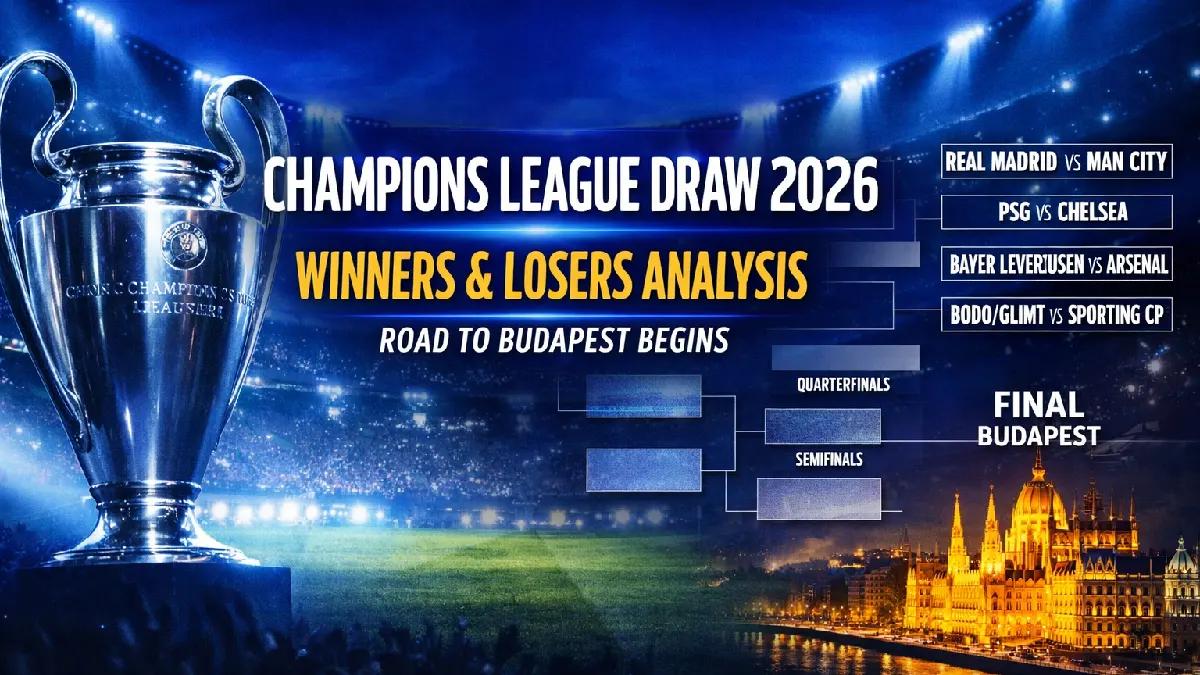
The road to Budapest is officially mapped — and the 2026 UEFA Champions League knockout bracket has already reshaped expectations across Europe.
The Champions League round of 16 draw didn’t just decide opponents. It determined momentum, fatigue levels, tactical pathways, and arguably who holds the strongest chance to reach the final on May 30.
Some clubs received a dream scenario. Others were handed a brutal survival test before spring even begins.
Below is a complete expert breakdown of the Champions League draw winners and losers, plus everything fans searched for — including what time is the Champions League draw, CET timings, and how to watch the ceremony live.
When Is the Champions League Round of 16 Draw? Time, CET Schedule & How to Watch
Search interest exploded around questions like:
- what time champions league draw
- what time is the champions league draw
- champions league round of 16 draw time
- when is the round of 16 champions league draw
- where to watch champions league draw
Here are the confirmed details.
Champions League Draw Time (Official)
- Date: Friday, February 27, 2026
- Location: House of European Football, Nyon, Switzerland
- Start Time: 12:00 CET (Central European Time)
- US Time: 6:00 AM ET
- UK Time: 11:00 AM GMT
The ceremony fixed the entire knockout bracket, meaning teams instantly learned their potential quarterfinal and semifinal opponents.
Where to Watch the Champions League Draw
Fans asking where to watch the Champions League draw or how to watch Champions League draw could follow it via:
- UEFA official website
- UEFA Champions League app
- UEFA YouTube livestream
- Sports broadcasters with UCL rights
The UEFA Champions League draw live broadcast remains free globally through UEFA digital platforms.
Champions League Round of 16 Fixtures (2026)
The draw produced a fascinating mix of heavyweight clashes and favorable matchups.
| Fixture | Narrative |
|---|---|
| PSG vs Chelsea | Tactical rematch with revenge storyline |
| Galatasaray vs Liverpool | High-intensity atmosphere tie |
| Real Madrid vs Manchester City | Modern European rivalry renewed |
| Atalanta vs Bayern Munich | Tactical vs structural dominance |
| Newcastle vs Barcelona | Rising force vs historic giant |
| Atletico Madrid vs Tottenham | Physical knockout battle |
| Bodo/Glimt vs Sporting CP | Underdog opportunity |
| Bayer Leverkusen vs Arsenal | Arsenal’s favorable pathway |
The knockout matches begin March 10–11, with second legs on March 17–18.
Winners of the Champions League Draw
Arsenal — The Clearest Path to the Final
Among all teams, Arsenal emerged as the biggest beneficiaries.
While knockout football always carries uncertainty, bracket difficulty still matters — and Arsenal avoided nearly every elite heavyweight until potentially late stages.
Why Arsenal Won the Draw
- Avoided Real Madrid, Manchester City, Bayern Munich, and Liverpool early
- Face Bayer Leverkusen instead of a European superpower
- Potential quarterfinal opponent: Sporting CP or Bodo/Glimt
- Majority of elite-ranked teams placed on opposite side
From a strategic perspective, tournament probability dramatically improves when early rounds minimize high-intensity clashes.
Arsenal’s path allows:
- Squad rotation during domestic title races
- Lower injury risk
- Tactical continuity under pressure
In modern Champions League formats, bracket luck often equals competitive advantage — and Arsenal received exactly that.
Bodo/Glimt — The Underdog Opportunity
For smaller clubs, success often depends less on quality gaps and more on matchup compatibility.
Bodo/Glimt avoided traditional giants and instead drew Sporting CP — a technically strong but beatable opponent.
Why this matters:
- Sporting generates fewer attacking shots compared to elite sides
- Norwegian side thrives in high-tempo transitional games
- Psychological momentum favors underdogs already exceeding expectations
A quarterfinal appearance would represent one of the greatest modern Champions League runs by a Scandinavian club.
Enzo Maresca and Chelsea — Tactical Familiarity Advantage
Chelsea’s tie against PSG carries narrative weight.
While PSG possess elite individual quality, Chelsea already demonstrated a tactical blueprint capable of disrupting them:
Key tactical advantages:
- Aggressive pressing systems
- Flexible midfield structure
- Fast transitional attacking patterns
Unlike previous encounters, Chelsea now approach the matchup without surprise pressure — a subtle but critical knockout-stage benefit.
Losers of the Champions League Draw
Manchester City and Real Madrid — The Endless Rivalry
No fixture defines modern European football more than this one.
For the fifth consecutive Champions League season, Manchester City and Real Madrid meet again — a remarkable statistical anomaly highlighting their dominance.
But the real issue isn’t just the opponent.
The Brutal Path Ahead
The winner likely faces:
- Bayern Munich in quarterfinals
- PSG, Liverpool, or Chelsea later
- Continuous elite-level matches with minimal recovery
This creates:
- Tactical exhaustion
- Increased injury probability
- Domestic league compromises
In knockout tournaments, difficulty stacking becomes decisive — and both giants landed on the toughest side of the bracket.
Tottenham — Success May Not Be Ideal
Paradoxically, Tottenham’s draw may work against their broader season goals.
With domestic pressures mounting, deep European progression could stretch an already thin squad.
Challenges include:
- Heavy fixture congestion
- Physical matchup against Atletico Madrid
- Limited squad depth compared to rivals
Sometimes the worst outcome isn’t elimination — it’s prolonged survival without realistic title chances.
The Hard Side vs Easy Side of the Bracket
One glance at the knockout tree reveals imbalance.
Hard Side (Elite Cluster)
- Real Madrid
- Manchester City
- Bayern Munich
- Liverpool
- PSG
- Chelsea
This half resembles a premature final-stage tournament.
Favorable Side
- Arsenal
- Barcelona
- Sporting
- Bodo/Glimt
- Leverkusen
Fewer historical Champions League winners sit here, reducing early-round volatility.
Bracket asymmetry is common but rarely this pronounced.
Tactical Themes Emerging From the Draw
1. Fixture Density Will Decide the Champion
Elite teams balancing domestic races face severe scheduling pressure.
Example scenario:
- League matches every weekend
- Two-legged European ties midweek
- Cup competitions overlapping
Squad depth becomes more valuable than star power.
2. Defensive Stability Matters More Than Attack
Several contenders entered the knockout stage with defensive inconsistencies.
Historically:
- Teams conceding frequently before quarterfinals rarely win UCL
- Compact defensive structure correlates strongly with final appearances
The draw amplifies these weaknesses for City and Madrid.
3. Momentum vs Experience
Younger squads like Arsenal and Newcastle benefit from momentum.
Traditional giants rely on institutional Champions League experience.
The 2026 knockout phase may ultimately test which factor matters more.
Champions League Knockout Schedule Overview
| Stage | Dates |
|---|---|
| Round of 16 | March 10–11 & 17–18 |
| Quarterfinals | April 7–8 & 14–15 |
| Semifinals | April 28–29 & May 5–6 |
| Final | May 30, Budapest |
The final will take place at Puskás Aréna in Hungary.
Expert Prediction: Who Benefits Most?
Based on bracket structure, squad balance, and matchup difficulty:
Top Title Probabilities (Post-Draw Projection)
- Arsenal — favorable pathway
- Bayern Munich — structural consistency
- Liverpool — high pressing reliability
- Barcelona — balanced progression route
Dark Horse: Bodo/Glimt
Biggest Risk: Manchester City or Real Madrid — due purely to pathway difficulty, not quality.
Final Verdict: A Draw That Changed the Competition
The Champions League draw often feels ceremonial. This one was transformative.
- Arsenal gained strategic advantage.
- European giants were forced into early elimination battles.
- Underdogs received realistic pathways to history.
In knockout football, talent wins matches — but draw structure shapes tournaments.
And this year, the path to Budapest may already favor those who avoided the early wars.