

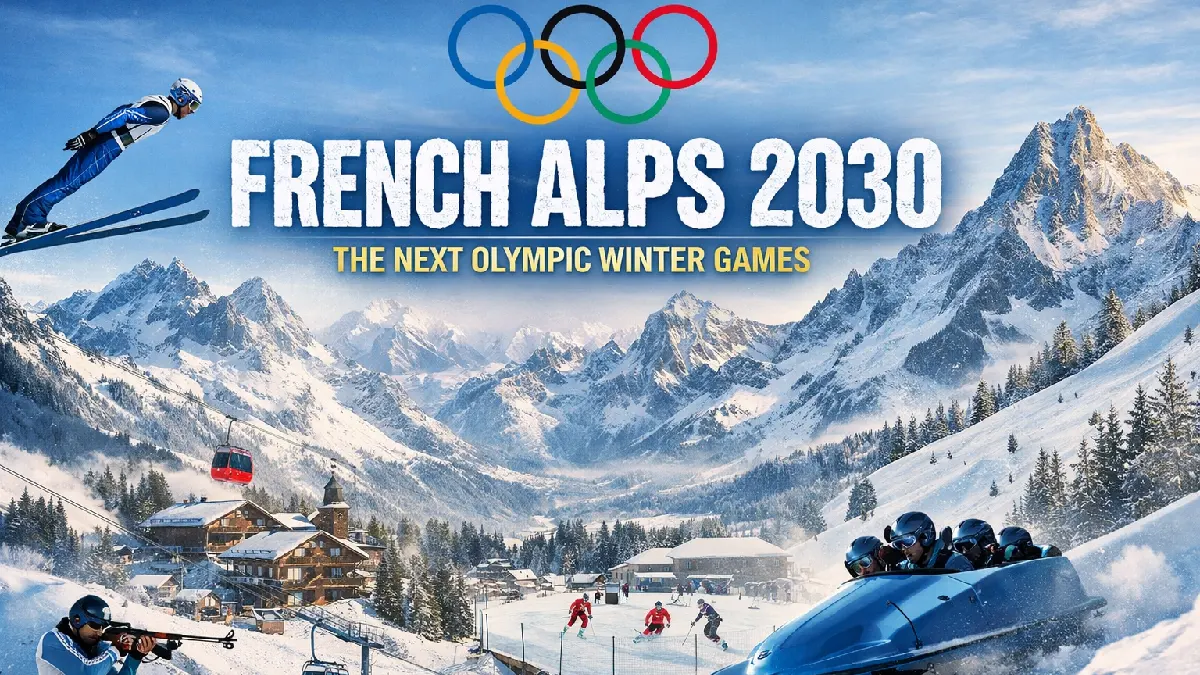
The Olympic flag is heading back to France.
After the curtain closed on Milano Cortina 2026, global attention shifted to the next host of the Olympic Winter Games — French Alps 2030. For the fourth time in history, France will stage the Winter Olympics, and expectations are already sky-high.
For U.S. audiences and winter sports experts, French Alps 2030 represents more than another edition of the Games. It signals a structural shift toward sustainability, regional integration, and long-term alpine legacy planning.
This guide breaks down everything you need to know — venues, sports, environmental strategy, governance decisions, and why this edition could redefine modern Winter Games.
French Alps 2030 Overview: Key Facts at a Glance
| Category | Details |
|---|---|
| Host Nation | France |
| Dates | 1–17 February 2030 |
| Previous French Winter Hosts | Chamonix 1924, Grenoble 1968, Albertville 1992 |
| Main Zones | Haute-Savoie, Savoie, Briançon, Nice |
| Core Sports | 7 confirmed winter sports |
| Organising Committee Chair | Edgar Grospiron |
Unlike centralized Winter Games of the past, French Alps 2030 will operate through a multi-zone alpine model, distributing events across established mountain regions.
Four-Zone Venue Strategy: A Regional Model
French Alps 2030 will utilize four primary clusters:
- Haute-Savoie
- Savoie
- Briançon
- Nice
This approach draws inspiration from Paris 2024’s extensive use of existing infrastructure. Nearly 93% of venues are expected to be either existing or temporary structures.
Why This Matters
For decades, Olympic hosts struggled with post-Games “white elephant” venues. French Alps 2030 aims to reverse that pattern by aligning facilities with long-term regional development plans.
Instead of building unnecessary permanent structures, organizers are prioritizing:
- Renovation over new construction
- Temporary overlays where feasible
- Integration with existing resort ecosystems
This decentralized approach reduces financial and environmental strain while strengthening local economies.
Confirmed Winter Sports Program
Seven sports are already expected to feature, consistent with every Winter Games since Nagano 1998:
- Biathlon
- Bobsleigh
- Curling
- Ice Hockey
- Luge
- Skating
- Skiing
The final discipline list and athlete quotas will be confirmed in 2026.
Potential Additions
The organizing committee may propose additional events. Final approval rests with the IOC.
For U.S. viewers, strong medal prospects are expected in skiing, skating, and bobsleigh — traditionally American strengths.
Sustainability: The Core Pillar of French Alps 2030
French Alps 2030 is positioning environmental responsibility at the center of its identity.
Climate change is reshaping winter sports. Alpine regions are experiencing reduced snowfall reliability and ecosystem pressure. Organizers have explicitly stated that the Games must contribute to long-term mountain resilience.
Transportation Innovation
Rather than expanding car parking infrastructure, planners are investing in multimodal transport hubs:
- Rail access from major cities
- Integrated bus systems
- Valley lift connections
A key project includes a lift linking Aime to La Plagne, designed to minimize car traffic between valley towns and resorts.
This strategy could allow spectators traveling from Paris to reach competition sites without using private vehicles.
For sustainability analysts, this represents a measurable shift toward low-carbon event logistics.
Governance and Leadership
The French Alps 2030 Organizing Committee is chaired by Edgar Grospiron, a former Olympic medalist in moguls.
Leadership has emphasized two commitments:
- Delivering a “spectacular” Games experience
- Anchoring decisions in environmental and regional realities
The ambition is not scale for spectacle’s sake, but strategic legacy.
Historical Context: France’s Winter Olympic Legacy
France previously hosted:
- Chamonix 1924 (first-ever Winter Olympics)
- Grenoble 1968
- Albertville 1992
Each Games reflected its era. French Alps 2030 must now respond to a different challenge — climate accountability and financial prudence.
Unlike Albertville’s infrastructure-heavy approach, 2030 focuses on integration.
Why French Alps 2030 Matters to the United States
For U.S. audiences, the Games offer several compelling angles:
- Time-zone accessibility for live broadcasts
- Strong American medal opportunities
- Policy case study for sustainable mega-events
- Commercial opportunities for U.S. sponsors
Major American winter sports federations are already mapping preparation cycles toward 2030 qualification benchmarks.
Comparing French Alps 2030 to Previous Winter Games
| Edition | Infrastructure Model | Sustainability Emphasis | Geographic Spread |
|---|---|---|---|
| Sochi 2014 | Heavy new builds | Limited | Compact |
| PyeongChang 2018 | Mixed | Moderate | Semi-compact |
| Beijing 2022 | Split zones | Emerging focus | Multi-zone |
| French Alps 2030 | Primarily existing venues | Core priority | Four alpine clusters |
French Alps 2030 continues the multi-cluster model but advances environmental alignment further.
Strategic Legacy Planning
The organizing committee has repeatedly emphasized long-term impact beyond 17 competition days.
Legacy goals include:
- Boosting year-round alpine tourism
- Strengthening rail connectivity
- Modernizing resort transport
- Supporting mountain communities
This mirrors broader independent planning principles — where each zone operates with strategic autonomy yet aligns under a unified framework.
Interestingly, the structure resembles academic discussions around independent assortment in meiosis — separate units operating independently but contributing to a combined outcome.
Clarifying “Independent” vs “Dependent” in Event Strategy
In science, independent assortment describes how genes distribute independently during meiosis. In contrast, what is a dependent variable refers to outcomes influenced by other factors.
Similarly:
- Each venue cluster operates independently
- Overall Games success is the dependent variable
This layered independence is intentional. It reduces systemic risk if one zone faces operational challenges.
Infrastructure Without Excess
French Alps 2030 aims to avoid overbuilding. Instead of expanding parking or constructing unnecessary arenas, planners emphasize:
- Valley-to-resort lift systems
- Public transport networks
- Temporary competition overlays
This philosophy aligns with broader policy trends favoring independent regional development over centralized mega-projects.
Climate Reality and Mountain Regions
Alpine regions face rising temperatures and snowfall variability. French Alps 2030 openly acknowledges these risks.
Environmental measures under consideration include:
- Carbon footprint tracking
- Energy-efficient venue retrofits
- Smart snow management systems
- Long-term biodiversity protection plans
For environmental policy experts, this Games will serve as a test case.
Media and Coverage Expectations in the U.S.
American coverage will likely focus on:
- U.S. medal projections
- Sustainability performance metrics
- Infrastructure innovation
- Athlete qualification pathways
While regional publications such as Marin Independent Journal or Valley Independent Sentinel may frame the Games through local athlete stories, national networks will highlight strategic implications.
Avoiding Financial Pitfalls
Olympic hosts often struggle with debt. French Alps 2030 attempts to mitigate this through:
- High percentage of existing venues
- Alignment with local development plans
- Reduced capital expenditure
The governance model appears structured to operate more like an independent clause in language — capable of standing on its own — rather than relying heavily on external financial rescue.
What Experts Should Watch
Key evaluation metrics leading up to 2030 include:
- Final sports program decisions in 2026
- Budget transparency reports
- Transport infrastructure completion timelines
- Carbon footprint benchmarks
- Snow reliability adaptation strategies
Each will determine whether French Alps 2030 fulfills its sustainability promise.
Broader Lessons for Mega-Event Planning
The Games represent a shift from spectacle-first to responsibility-first planning.
Conceptually, it reflects the law of independent assortment — diversified components contributing to a unified system.
In governance terms:
- Regions operate semi-independently
- Central coordination ensures consistency
- Legacy planning drives investment logic
This hybrid approach may shape future Olympic bidding models.
Final Outlook: A Defining Winter Olympics
French Alps 2030 is not simply another Winter Games. It is a strategic recalibration.
France is betting that:
- Distributed venues reduce environmental strain
- Public transport investment enhances legacy value
- Regional autonomy strengthens resilience
If executed effectively, French Alps 2030 could become the blueprint for climate-conscious winter sport mega-events.
For U.S. sports analysts, policymakers, and Olympic followers, the next four years will offer a detailed case study in balancing spectacle with sustainability.
The Olympic Winter Games return to the mountains — but this time, the focus is not just on medals, but on measurable impact.